






 Casa
Casa Productos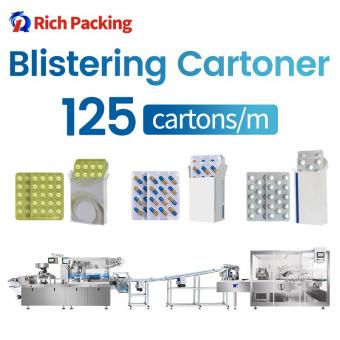
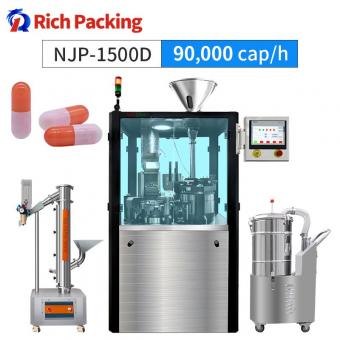
29+ years in pharmaceutical machinery, covering capsule filling, tablet pressing, blister packaging, tablet and capsule counting, cartoning, GMP production, and overseas machine service.


A recent New York Times article, “Americans Are Taking More Supplements Than Ever, Despite Experts’ Doubts,” pointed out that nearly 8 in 10 adults in the United States currently take at least one dietary supplement, while the global supplement industry is estimated to be worth around $228 billion.
As the supplement market continues to expand, manufacturers are no longer dealing with only standard tablets and capsules. Powders, granules, gummies and other supplement formats are becoming increasingly common, while packaging options now range from bottles and blister packs to stick packs, sachets and cartons.
For pharmaceutical and nutraceutical manufacturers, this makes machinery selection increasingly important. Choosing the right equipment is not only about matching the machine to the product, packaging format and required output. Manufacturers also need to consider whether the equipment can meet the regulatory expectations of the target market, whether sufficient technical and validation documentation can be provided, and whether reliable installation and after-sales support is available.
These factors become particularly important when sourcing pharmaceutical and supplement machinery internationally, including from China. A machine may be able to produce the required package, but that does not automatically mean it is suitable for installation, qualification and long-term operation in the manufacturer's target market.
In this article, we will look at the most common supplement packaging formats, the machinery typically used for each, and the key factors manufacturers should evaluate before selecting a production or packaging machine.
Different supplement products require different packaging processes. Before selecting a machine, manufacturers should first confirm the product form, the final packaging format and the expected production capacity.
The table below provides a quick overview of common supplement products, their typical packaging formats and the main factors to consider when selecting the corresponding equipment.
|
Supplement Product |
Common Packaging Format |
Recommended Packaging Machine |
Key Selection Focus |
|
Capsules and tablets |
Bottles |
Counting and bottling line |
Counting accuracy, bottle size, output, changeover |
|
Capsules and tablets |
Blister packs |
Blister packaging machine |
Packaging material, blister layout, sealing quality, tooling changeover, cleaning |
|
Powders and granules |
Stick packs / sachets |
Stick pack / sachet packaging machine |
Filling accuracy, product flowability, pack size, number of lanes |
|
Gummies |
Bottles / jars |
Counting and bottling machine |
Product size, stickiness, feeding stability, counting accuracy |
|
Finished bottles, blisters and stick packs |
Cartons |
Cartoning machine |
Product dimensions, carton size, feeding method, leaflet insertion |
These specifications help determine the basic machine configuration. However, technical parameters alone should not be used to make the final purchasing decision. Compliance with the target market, machine documentation, validation support and after-sales capability should also be evaluated before equipment is selected.

Bottle packaging is one of the most common formats for capsules and tablets, especially for vitamins, minerals and other daily-use supplements.
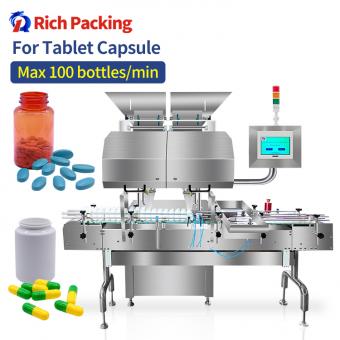
A typical automatic counting and bottling line may include a bottle unscrambler, electronic counting machine, desiccant inserter, capping machine, induction sealer and labeling machine. When selecting the line, manufacturers should mainly consider product size, bottle specifications, counting accuracy, required output and changeover between different products or bottle formats.
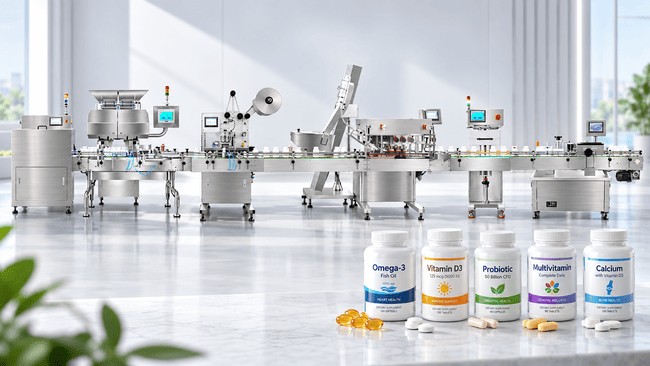
Automatic Counting & Bottling Line for Supplements
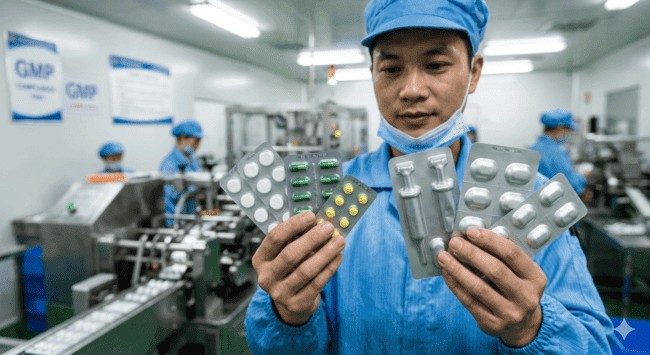
Blister packaging is another common choice for capsules and tablets. Depending on the required barrier performance, products can be packed in structures such as PVC-Alu or Alu-Alu.
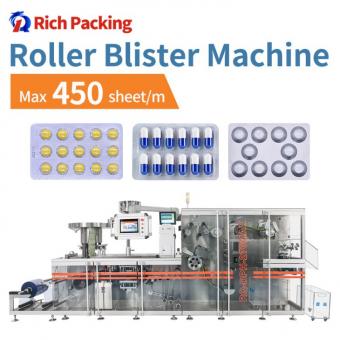
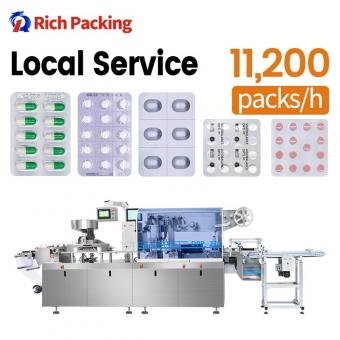
A blister packaging machine normally completes forming, feeding, sealing and cutting in one continuous process. In addition to output, manufacturers should pay attention to sealing stability, finished blister quality and tooling changeover, especially when the same machine will be used for several products or blister layouts.
Powder and granule supplements such as collagen powder, electrolyte powder, probiotics and vitamin powders are commonly packed in stick packs or sachets.
The packaging machine integrates dosing, filling, sealing and cutting, while multi-lane configurations can provide higher output. Machine configuration should be based on the actual product characteristics, filling weight, packaging dimensions and required production capacity.

Stick Pack Packaging for Powder & Granule Supplements

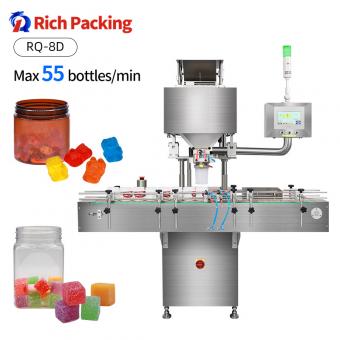
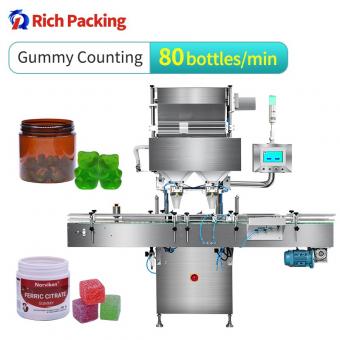
Gummy supplements are also commonly packed in bottles or jars. However, because gummies can be softer, larger, irregular in shape or slightly sticky, the feeding and counting system should be configured according to the actual product rather than treated in exactly the same way as standard capsules or tablets.
Product testing before final machine configuration is therefore particularly important.
After primary packaging, bottles, blister packs and stick packs can be further packed into cartons.
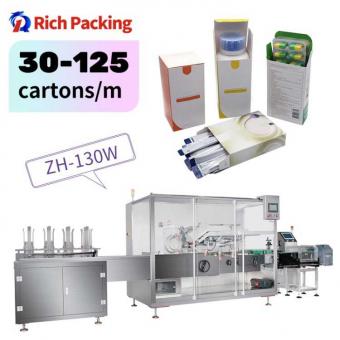
An automatic cartoning machine can complete carton opening, product loading, leaflet insertion and carton closing, and it can also be connected directly with upstream packaging equipment to create a more complete automated line.

Selecting a supplement packaging machine is not simply about finding a machine that can handle the product at the required speed.
A machine may successfully produce bottles, blister packs or stick packs during a demonstration, but manufacturers also need to consider whether the equipment is suitable for the target market, whether the required technical documentation can be provided, how the machine will be tested and accepted, and what support will be available after installation.
This becomes especially important when sourcing pharmaceutical and nutraceutical machinery internationally, including from China.
A machine that can produce your product is not necessarily a machine that is ready for your market.
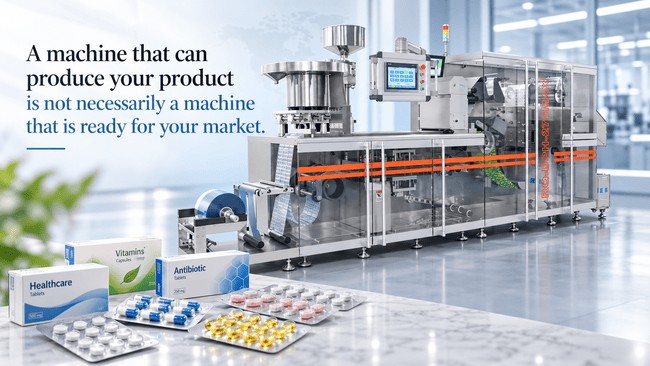
Before comparing machine models or requesting quotations, manufacturers should first determine where the equipment will ultimately be installed and operated.
The target market can directly affect machine design, safety systems, electrical configuration, product-contact materials, components and documentation requirements. This is especially important when sourcing pharmaceutical and nutraceutical machinery internationally, including from China.
For European projects, buyers may need to consider applicable CE conformity requirements, machinery safety requirements, electrical safety and EMC requirements.
For pharmaceutical or nutraceutical projects in the United States, relevant cGMP and FDA / 21 CFR requirements may also need to be considered depending on the product, production process and intended use of the equipment.
The purpose of this early assessment is not simply to create a list of certificates to request from the supplier. It is to understand what the target market may require from the actual equipment design and project documentation.
For example, market and project requirements may affect:
These requirements should therefore be identified at the beginning of the project, rather than checked only after the machine has already been manufactured. Your existing article already emphasizes that installation market can affect design, safety, electrical configuration, materials and documentation.
Once the product, packaging format and target-market requirements are clear, they should be translated into a User Requirement Specification (URS).
A URS defines what the customer expects the equipment to achieve and gives different suppliers a common basis for preparing machine configurations, technical proposals and quotations.
The URS does not need to be unnecessarily complicated, but it should clearly define the key requirements of the project, such as:
For projects involving multiple suppliers, a clear URS also makes quotation comparison much more meaningful because each supplier is responding to the same set of requirements.
This is particularly useful when comparing quotations that appear similar at first glance. Buyers can check whether the same tooling, documentation, electrical components, FAT support, installation services and other project requirements are actually included.
Tooling requirements should also be clarified at this stage. For equipment that may handle multiple products or packaging formats, buyers should understand the price of additional molds or change parts, the tooling material and lead time, and whether compatible tooling can be sourced from qualified third-party suppliers or only from the original machine manufacturer.
A lower initial machine price may not necessarily mean a lower long-term cost if future tooling, spare parts or change parts are expensive or available from only one source.
Most importantly, the URS should reflect the findings of the target-market assessment. It should not be prepared only around production speed and packaging dimensions.
A URS is useful only if its requirements are reflected in the final machine.
For this reason, buyers should not simply ask:
“Does this machine have CE?”
or
“Is this machine cGMP compliant?”
They should also ask how the agreed requirements are implemented in the machine design.
For example, if the URS specifies particular product-contact materials, safety systems, electrical components or access-control requirements, these items should be confirmed during technical review and later verified during FAT.
This creates a much clearer project logic:
Target Market Requirements → URS → Machine Design → FAT Verification
For pharmaceutical and nutraceutical equipment, the machine itself is only part of the delivery.
Technical documentation is important for installation, operation, maintenance, equipment acceptance and future validation activities.
Before placing an order, manufacturers should clarify exactly what documentation will be delivered with the equipment.
Depending on the machine and project requirements, the documentation package may include operating manuals, electrical diagrams, pneumatic diagrams, machine layouts, component lists, spare-parts lists, technical specifications and relevant material or component documentation.
For projects with stricter qualification requirements, buyers should also discuss the availability of documents supporting FAT, IQ, OQ and validation activities.
A common mistake when sourcing machinery is to focus heavily on the machine during the purchasing stage and only ask for technical documents after shipment.
By that point, obtaining missing records or rebuilding project documentation can become much more difficult.
For this reason, the required document list should be confirmed together with the technical specifications before production begins.
|
Document |
Purpose |
When to Confirm |
|
User Manual |
Operation, setup, cleaning and maintenance |
Before production begins |
|
Electrical Diagram |
Electrical installation and troubleshooting |
Before manufacturing |
|
Pneumatic Diagram |
Air circuit identification and maintenance |
Before manufacturing |
|
Machine Layout |
Factory layout and utility planning |
Before order / before production |
|
Component / Parts List |
Spare parts and future maintenance |
Before shipment |
|
FAT Documents |
Test procedures, records and acceptance results |
Before FAT |
|
IQ / OQ Support Documents |
Installation and operational qualification activities |
Before project execution |
Factory Acceptance Testing, or FAT, gives the manufacturer an opportunity to verify the equipment before it leaves the supplier's factory.
A FAT should not simply show that the machine can start and run.
Depending on the project, the customer may verify machine configuration, major components, materials, tooling, operating parameters, production speed, safety functions and finished-product quality against the agreed technical requirements.
Actual packaging materials and products should be used for testing whenever possible.
For example, with a blister packaging machine, FAT may include checking forming, feeding, sealing, cutting, finished blister appearance, tooling changeover and machine alarms.
For a counting line, the customer may focus more on counting accuracy, bottle handling, line synchronization and finished bottle quality.
Any adjustments identified during FAT can then be completed before shipment.
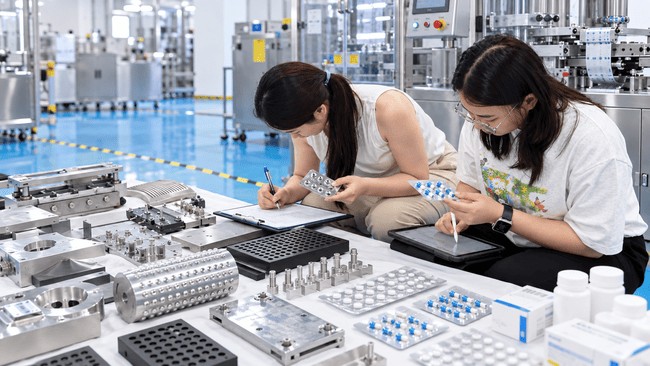
Factory Acceptance Testing Before Shipment
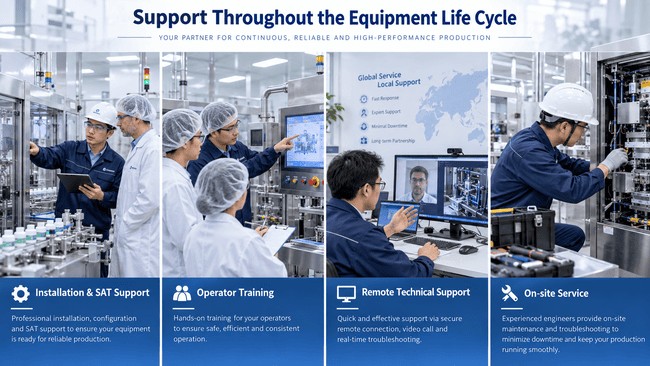
The machine still needs to perform correctly after arriving at the customer's production site.
This is where SAT, installation, commissioning and operator training become important.
Site Acceptance Testing can be used to confirm machine operation after transportation and installation and to verify that the equipment works under the customer's actual production conditions.
For pharmaceutical projects, installation and operational qualification activities may also form part of the customer's wider validation process.
The exact responsibility of the machine supplier and the manufacturer should therefore be discussed before the project begins.
Buyers should understand what support is included, what documents will be provided and whether assistance is available for installation, commissioning, IQ/OQ or other qualification activities.
After-sales service should be evaluated before the machine is purchased, not when a problem occurs.
This is particularly important for manufacturers purchasing equipment from an overseas supplier.
Before selecting a supplier, buyers should understand how installation guidance, operator training, troubleshooting, spare parts and future change parts will be handled.
They should also ask practical questions:
These factors may not appear in the headline machine specifications, but they can have a significant impact on production downtime and the long-term usability of the equipment.
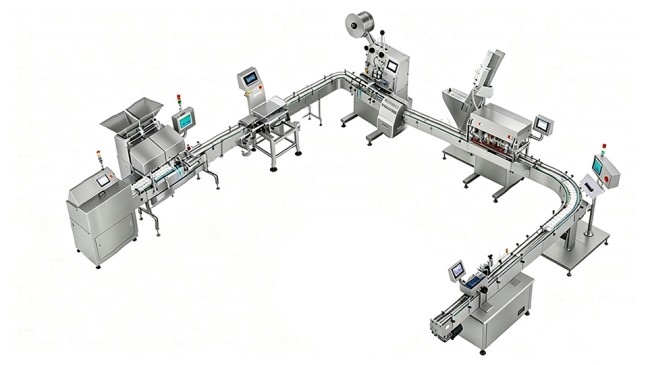
Packaging machinery should also be considered as part of the complete manufacturing process rather than as isolated equipment.
For capsule products, for example, the production process may include capsule filling, polishing and sorting, metal detection, by bottle or blister packaging and secondary cartoning.
Tablet products can move from tablet production into bottle or blister packaging, while powder products can connect with stick pack packaging systems.
The ideal configuration depends on the product, required capacity, factory layout and level of automation.
Planning the complete process from the beginning can make it easier to connect upstream and downstream equipment and avoid unnecessary modifications later.
The growth and diversification of the supplement market are creating more packaging choices for manufacturers, from bottles and blister packs to stick packs and cartons.
Choosing the correct packaging format and machine is the first step, but machine selection should not stop at product compatibility, output and price.
Manufacturers should also consider whether the equipment is suitable for the requirements of the target market, whether complete technical and validation documentation is available, how the machine will be tested through FAT and SAT, and what technical support will be available after installation.
Especially when sourcing pharmaceutical and nutraceutical machinery internationally, these factors can be just as important as the machine specifications themselves.
Rich Packing provides machinery for capsule, tablet, powder and other supplement production and packaging applications, including capsule filling machines, tablet presses, counting and bottling lines, blister packaging machines, stick pack machines and cartoning machines.
In addition to machine configuration, Rich Packing can support customers with FAT, technical documentation, installation guidance, training and after-sales service according to individual project requirements.
Start with the product form, packaging format, filling quantity, package dimensions, required output and automation level.
For example, capsules and tablets may be packed in bottles or blister packs, powders and granules are commonly packed in stick packs, while gummies usually require a feeding and counting system configured according to their actual size, shape and stickiness.
Do not compare only the final machine price.
Check whether the quotations include the same machine configuration, materials, electrical components, tooling, accessories, documentation, FAT support, installation service, spare parts and warranty conditions.
A lower quotation may simply exclude items that will need to be purchased separately later.
For this reason, it is better to request a clear and itemized quotation before comparing suppliers.
Tooling can become an important long-term cost when one machine is used for several products, sizes or packaging formats.
Before ordering the machine, buyers should confirm:
Most importantly, ask whether replacement tooling can be produced by other qualified suppliers or whether it can only be purchased from the original machine manufacturer.
A machine with a low initial price may become expensive to operate if every future mold or change part must be purchased from one supplier at an unusually high price.
So when comparing quotations, buyers should evaluate whether the tooling price is reasonable as well as the machine price.
The installation country should be discussed before the machine configuration is finalized.
Different markets may require different safety systems, electrical configurations, product-contact materials, machine guarding, documentation and other design considerations.
For European projects, buyers may need to consider applicable CE, machinery safety, electrical safety and EMC requirements. For pharmaceutical or nutraceutical projects in the United States, relevant cGMP and FDA / 21 CFR requirements may also need to be considered depending on the application.
The exact document package depends on the equipment and project requirements, but it may include:
User manuals, electrical diagrams, pneumatic diagrams, machine layouts, component lists, spare-parts lists, technical specifications and relevant material or component documentation.
For projects with stricter qualification requirements, FAT, IQ/OQ and validation-related documentation should also be discussed before production begins.
FAT should be carried out strictly against the buyer’s approved URS and the agreed technical specifications, rather than simply confirming that the machine can start and run.
Each key requirement defined in the URS should be verified during FAT wherever applicable, including:
Whenever possible, the FAT should be performed using the customer’s actual product, packaging materials and tooling.
Any deviation from the URS or agreed specifications should be recorded, corrected and reconfirmed before shipment.
FAT is normally carried out at the supplier's factory before shipment to verify that the machine meets the agreed technical requirements.
SAT is carried out after installation at the customer's site to confirm that the equipment operates correctly under actual production conditions.
Depending on the project, SAT may be by commissioning, operator training and qualification activities such as IQ/OQ.
After-sales support should be discussed before purchasing the machine.
Buyers should confirm how the supplier handles installation guidance, commissioning, operator training, remote troubleshooting, on-site service, spare parts and future change parts.
It is also worth asking how quickly technical support can respond and whether spare parts, tooling and technical records will still be available several years after delivery.

29+ years in pharmaceutical machinery, covering capsule filling, tablet pressing, blister packaging, tablet and capsule counting, cartoning, GMP production, and overseas machine service.

Correo electrónico : manager@richpacking.cn
Building D, No. 226, Beishan Qiaotou Street, Haizhu District, Guangzhou City, Guangdong Province, China


 Red IPv6 admitida