






 Casa
Casa Productos
29+ years in pharmaceutical machinery, covering capsule filling, tablet pressing, blister packaging, tablet and capsule counting, cartoning, GMP production, and overseas machine service.


Cuando abres una cápsula dura, puedes esperar ver polvo. El polvo es común, pero está lejos de ser el único material que se puede colocar dentro de una cápsula. Dependiendo de la formulación y el método de producción,contenido de la cápsulaPueden incluir polvos, gránulos, pastillas, minicomprimidos y líquidos o semisólidos adecuados.
Estas presentaciones no solo difieren en apariencia. Un polvo fino se comporta de manera diferente a los gránulos sueltos, mientras que las minicomprimidos deben manipularse como unidades individuales.Cápsulas duras rellenas de líquidorequieren otro método de dosificación y, por lo general, consideraciones adicionales sobre el sellado.
Esto significa que el material dentro de una cápsula afecta directamente la forma en que se fabrica el producto y el tipo de configuración de llenado de cápsulas que se requiere. No se debe asumir automáticamente que una máquina de llenado de cápsulas diseñada para polvo puede procesar gránulos, minicomprimidos o líquidos con el mismo mecanismo de dosificación.
| Contenido de la cápsula | ¿Cómo se ve? | Método de llenado típico |
|---|---|---|
| Polvo | Partículas secas finas o mezclas de polvos | Sistema de dosificación de polvo |
| Gránulos | Partículas más grandes e irregulares | Alimentación y dosificación de gránulos |
| Pellets | Partículas pequeñas, generalmente redondeadas | Sistema de dosificación de pellets |
| Minitabletas | Comprimidos pequeños | Sistema de tambor dosificador/de listones (conteo por volumen) |
| Líquidos y semisólidos | Aceites, soluciones adecuadas, suspensiones o rellenos semisólidos. | Dosificación por bombeo y sellado adicional |
Las siguientes secciones explican qué es cada tipo de relleno, por qué lo utilizan los fabricantes y cómo el material modifica el proceso de llenado de las cápsulas.
Una cápsula dura tiene dos partes principales: unacuerpo, que recibe el material de relleno y untapa, que se cierra sobre el cuerpo después de llenarse. La cubierta y el material en su interior son partes separadas de la cápsula terminada.
Elcubierta de la cápsulaPueden estar hechas de materiales como gelatina o HPMC. El contenido de la cápsula, por otro lado, es la formulación que se coloca dentro de la cubierta. Esta distinción es importante porque, al hablar de la composición de las cápsulas, a menudo se confunde el material de la cubierta con el del relleno.
Las cápsulas duras pueden contener polvos, gránulos, pellets y minicomprimidos. También se pueden introducir líquidos no acuosos y formulaciones semisólidas adecuadas en las cápsulas duras cuando la cubierta, la formulación, el proceso de llenado y el método de sellado sean compatibles. La terminología de la FDA sobre formas farmacéuticas también distingue entre cápsulas rellenas de polvo, de pellets y de líquido.
Una cápsula también puede contener más de un tipo de material. Algunas formulaciones utilizanrellenos combinadoscomo por ejemplo, gránulos con polvo o minicomprimidos con gránulos. Esto puede ayudar a mantener los componentes físicamente separados cuando tienen diferentes formulaciones o requisitos de liberación.
Por lo tanto, la elección del contenido de la cápsula comienza con la formulación en lugar de con laMáquina de llenado de cápsulasLos fabricantes determinan primero qué contiene la cápsula, cuánto se debe llenar y cómo se comporta el material durante la producción. A continuación, se puede seleccionar la configuración adecuada de la máquina de dosificación y llenado de cápsulas.
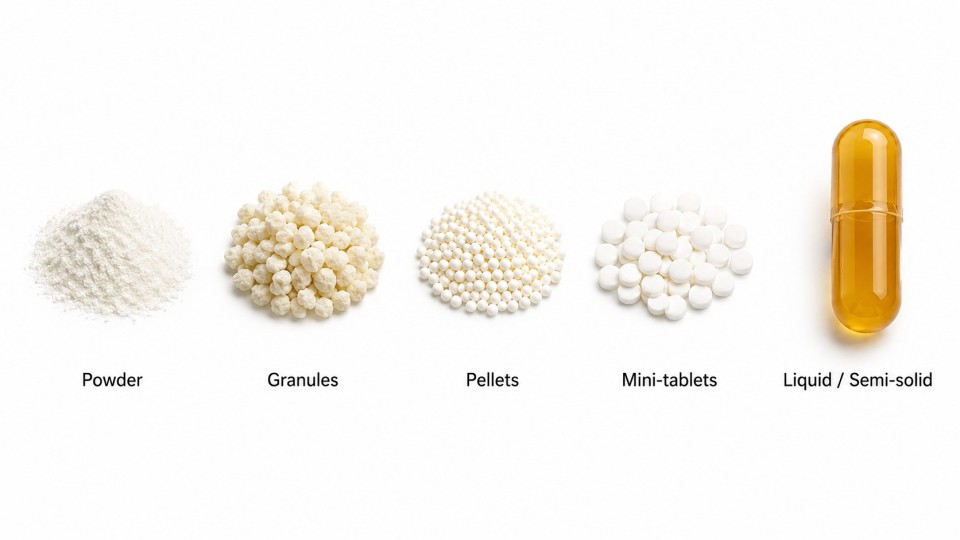
El polvo es uno de los materiales más comunes que se encuentran dentro de las cápsulas duras. En muchos productos, el polvo de la cápsula es una mezcla del ingrediente principal y excipientes seleccionados para facilitar el procesamiento, la estabilidad o el rendimiento del producto.
No todos los polvos se comportan de la misma manera. El tamaño de partícula, la distribución del tamaño de partícula, la densidad aparente, el nivel de humedad, la cohesión y la fluidez pueden afectar la forma en que el polvo se desplaza a través de la máquina de llenado de cápsulas y la uniformidad de su dosificación.
En una máquina automática de llenado de cápsulas con sistema de discos dosificadores, el polvo entra por los orificios de dosificación y se compacta mediante varillas de llenado. El grosor de los discos dosificadores permanece fijo durante el funcionamiento, mientras que la profundidad de las varillas de llenado es uno de los ajustes que se utilizan para controlar la cantidad dosificada.
Los ajustes de la máquina son solo una parte del proceso. Las propiedades del polvo, el suministro de material, las condiciones de dosificación, la repetibilidad mecánica y los controles de producción también contribuyen a un llenado uniforme.
Los gránulos son partículas aglomeradas de mayor tamaño, formadas a partir de partículas de polvo más pequeñas. Suelen tener una forma más irregular que los pellets y su tamaño puede variar según su proceso de fabricación.
Los fabricantes pueden utilizar la granulación para mejorar la manipulación y la fluidez en formulaciones adecuadas o para reducir la segregación entre los ingredientes. Dentro de una cápsula dura, los gránulos suelen tener el aspecto de granos gruesos en lugar de polvo fino.
Aunque tanto los gránulos como los polvos son materiales sólidos para el relleno de cápsulas, no se alimentan de la misma manera. El tamaño del gránulo, la densidad aparente, la friabilidad y el comportamiento del flujo deben coincidir con la configuración de alimentación y dosificación de la máquina de llenado de cápsulas.
Por eso, un proveedor de máquinas de llenado de cápsulas necesita saber que el contenido previsto de las cápsulas son gránulos, en lugar de que solo se le indique el tamaño de la cápsula y la producción prevista.
gránulos de cápsulaSon pequeñas unidades particuladas, a menudo de tamaño relativamente uniforme y de forma más regular que los gránulos convencionales. Una cápsula rellena de gránulos puede contener muchos gránulos individuales.
Los gránulos son útiles cuando los fabricantes desean dividir una formulación en varias unidades pequeñas. Además, se pueden fabricar o recubrir diferentes poblaciones de gránulos y luego combinarlos dentro de la misma cápsula. Esto hace que los gránulos sean útiles para formulaciones multiparticuladas y productos donde los componentes deben permanecer físicamente separados.
Los gránulos también requieren un método de llenado diferente. En lugar de compactar un tapón de polvo, el sistema de dosificación dosifica las partículas en movimiento libre, minimizando los daños y manteniendo una cantidad constante.
Por lo tanto, una configuración estándar para polvo en una máquina de llenado de cápsulas no debe considerarse automáticamente como una configuración para llenado de gránulos. Los componentes de dosificación específicos o adaptados se seleccionan según el producto y el diseño de la máquina de llenado de cápsulas.
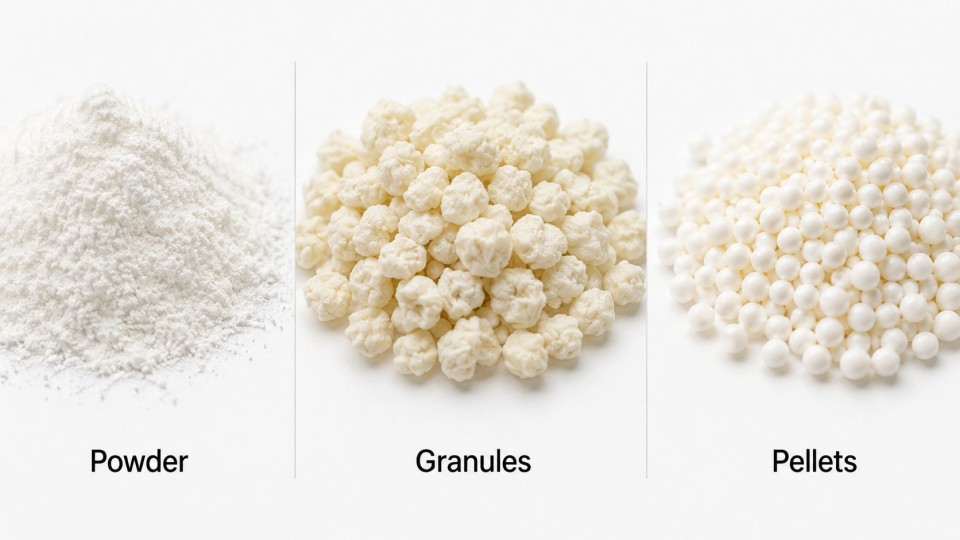
El polvo, los gránulos y los pellets tienen diferentes formas de partículas.
Las minicomprimidos son pequeñas tabletas comprimidas diseñadas para caber dentro de una cápsula. Demuestran por qué la respuesta a la pregunta "¿qué hay dentro de una cápsula?" no siempre es polvo o partículas sueltas.
Una cápsula dura puede contener una minicomprimido, varias minicomprimidos o minicomprimidos combinados con otros componentes, como gránulos. Las unidades de compresión separadas ayudan a mantener los diferentes componentes físicamente separados dentro de la cápsula.
Desde la perspectiva de la máquina de llenado de cápsulas, las minicomprimidos son muy diferentes del polvo. Son piezas individuales, por lo que la máquina de llenado de cápsulas necesita un sistema de dosificación mecánica adecuado que pueda suministrar la cantidad requerida a cada cápsula.
Por lo tanto, la cantidad y las dimensiones de las minicomprimidos son importantes a la hora de especificar un proyecto de máquina de llenado de cápsulas.
Las cápsulas duras también pueden contener líquidos adecuados y formulaciones semisólidas. Si bien los productos con relleno líquido suelen asociarse con las cápsulas blandas, las cápsulas duras con relleno líquido también constituyen una opción de dosificación consolidada.
La formulación debe ser compatible con la cubierta de la cápsula. La viscosidad, la composición, la temperatura de llenado, la interacción con la cubierta y el riesgo de fugas pueden afectar la producción.
AMáquina de llenado de cápsulas líquidasGeneralmente, se utiliza un sistema de dosificación con bomba controlada para introducir el volumen necesario en el cuerpo de la cápsula. Tras el llenado, se cierran la tapa y el cuerpo, y las cápsulas duras rellenas de líquido suelen requerir un proceso de sellado o cierre adecuado para reducir el riesgo de fugas.
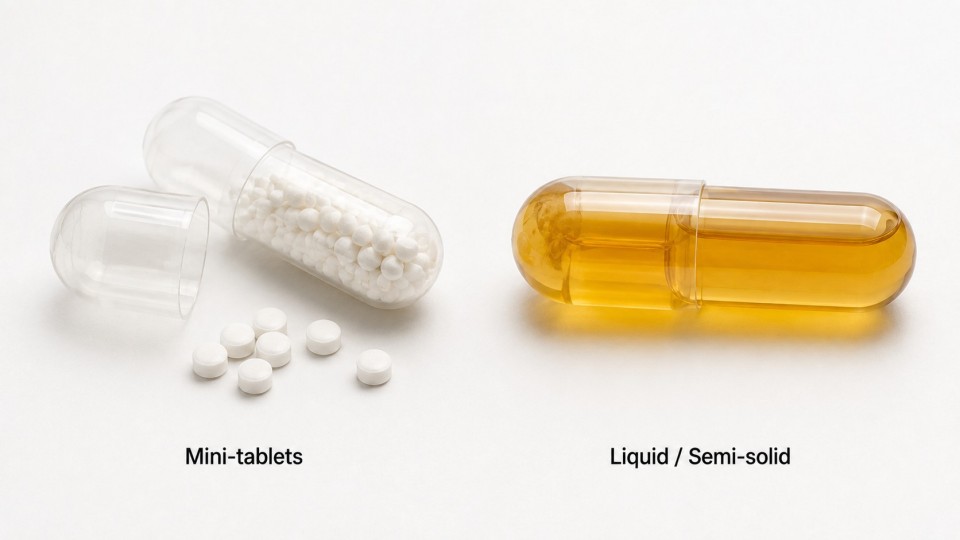
No existe una única forma de encapsulado óptima para todos los productos. Los fabricantes seleccionan polvo, gránulos, pastillas, minicomprimidos o líquidos según la formulación y el proceso de producción.
El polvo puede ser adecuado cuando los ingredientes se pueden mezclar y dosificar de forma consistente como una mezcla seca. Los gránulos ofrecen características de manipulación útiles. Los pellets y las minicomprimidos crean unidades separadas dentro de la cápsula, mientras que los sistemas líquidos o semisólidos adecuados constituyen otra opción para formulaciones que se manipulan mejor en ese formato físico.
Las distintas formas de llenado también permiten diseños de productos más complejos. Las diferentes poblaciones de gránulos pueden permanecer separadas dentro de la misma cápsula, mientras que las minicomprimidos pueden combinarse con gránulos u otros rellenos adecuados.
| Necesidad de producción o formulación | Possible Capsule Content |
|---|---|
| Conventional dry blend | Powder |
| Larger particulate fill | Granules |
| Multiparticulate formulation | Pellets |
| Separate compressed units | Mini-tablets |
| Suitable oil, liquid, or semi-solid formulation | Liquid or semi-solid |
| Multiple physically separate components | Combination fill |
These are not fixed one-to-one rules. The final choice depends on formulation development, product performance, manufacturability, capsule compatibility, and the availablecapsule filling process.
For capsule filling machine buyers, the key point is: capsule contents are decided by the product first, and the capsule filling machine configuration follows from that decision.
The basic job of a capsule filling machine is to separate the empty capsule body and cap, place the required contents into the body, close the capsule, and discharge the finished product. The dosing method changes with the material.
Powder can be handled by a dosing-disc system. Powder enters the dosing area, fills the dosing holes, is compacted by filling rods, and is transferred into the capsule bodies.
For dosing-disc capsule filling machines, filling-rod depth is an important adjustment used to control fill amount, while the dosing-disc thickness remains fixed during operation.
Granules are generally filled using volumetric, non-compression dosing rather than being compressed into a powder plug.
Free-flowing granules can enter a defined dosing chamber or slide-gate metering space mainly under gravity. Once the required volume has been measured, the granules are transferred into the capsule body.
Granule size, size distribution, bulk density, friability, and flow behavior influence how consistently the dosing volume fills. The exact dosing mechanism depends on the capsule filling machine design and the characteristics of the granules.
Pellets are also commonly filled using volumetric, non-compression dosing. Depending on the capsule filling machine design, free-flowing pellets and granules can use similar slide-gate, dosing-chamber, or other volumetric metering principles.
The main difference is that pellets, especially coated pellets, often require gentler handling to protect their shape and surface coating. Pellet size, flow behavior, coating characteristics, target quantity, and production speed should therefore be provided when specifying the capsule filling machine.
Mini-tablets are handled as individual solid units. A capsule filling machine can use a slat system or metering-drum system, which performs counting-by-volume. Cavities or metering spaces are designed to receive a defined number of mini-tablets and then transfer them into the capsule bodies.
A liquid capsule filling machine uses a pump-based dosing arrangement rather than a powder dosing mechanism. The system meters the formulation into the open capsule body, after which the capsule is closed and, when required, sealed or banded.
Temperature and viscosity can be important for certain semi-solid formulations because the material must remain suitable for pumping and dosing.
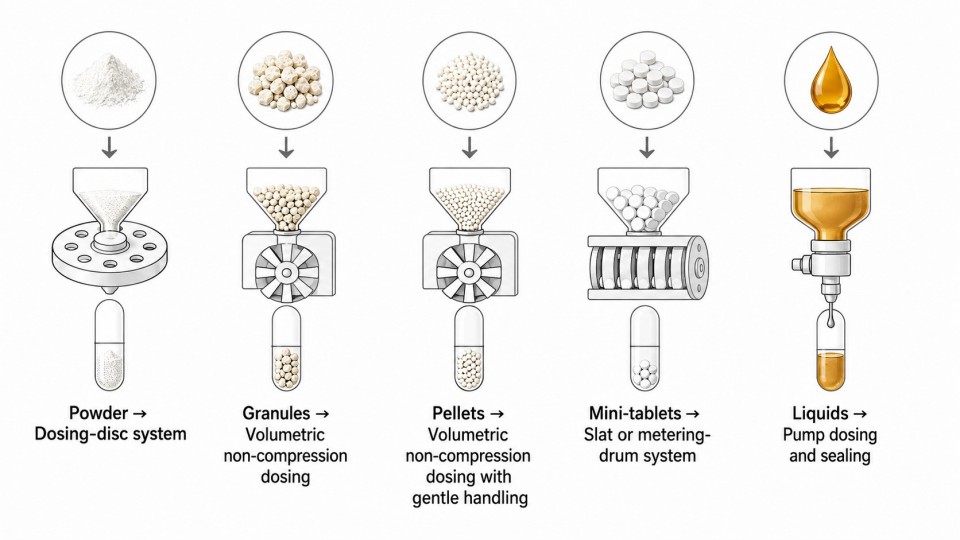
Different capsule contents require different dosing methods
If you are purchasing a capsule filling machine, specifying only the capsule size and required output is not enough. The supplier first needs to understand exactly what will be placed inside the capsule.
State whether the capsule contains powder, granules, pellets, mini-tablets, liquid, semi-solid material, or a combination.
For powder, bulk density and flow behavior are useful. For pellets and granules, particle size and size distribution become more important. For liquids, viscosity and filling temperature can affect the dosing approach.
Capsule size affects available internal volume and tooling. Common projects usecapsule sizes from #000 to #5, but the selected size must also provide enough space for the required capsule contents.
For powder, granules, or pellets, the supplier needs the required fill weight or volume. For mini-tablets, the required number of units and corresponding slat or metering-drum configuration need to be defined.
The capsule filling machine must match planned output. Capacity should be considered together with the material and dosing method rather than as an isolated specification.
If the capsule contains more than one component, explain this early. Powder plus pellets, several mini-tablets, or multiple pellet populations can require additional dosing stations or a different capsule filling machine configuration.
For liquid-filled hard capsules, the supplier should know the formulation type, viscosity range, capsule-shell compatibility, operating temperature, dosing requirements, and planned sealing process.
A conventional powder capsule filling machine should not be purchased on the assumption that it can later become a liquid capsule filling machine simply by changing ordinary powder tooling.
Manufacturers producing several products should consider how often they will change capsule sizes, fill materials, or dosing requirements. Frequent changeovers affect tooling, cleaning, adjustment time, and production scheduling.
As a pharmaceutical and packaging equipment supplier, Rich Packing works with manufacturers to match capsule contents, capsule size, target fill amount, production output, and special dosing requirements with the appropriate capsule filling machine configuration. When needed, the capsule filling process can also be considered together with downstream packaging requirements to build a more practical production setup.
A hard capsule can contain much more than powder. Capsule contents commonly include powders, granules, pellets, mini-tablets, and suitable liquids or semi-solids.
Each fill form has different physical characteristics and manufacturing requirements. Those differences determine how the material must be measured, fed, and transferred into the capsule.
For manufacturers and capsule filling machine buyers, the sequence is:
define the capsule contents → understand the material properties → determine the dosing method → select the appropriate capsule filling machine configuration.
Starting with what goes inside the capsule makes it easier to select a capsule filling machine that matches the actual production process rather than choosing one based only on capsule size or rated speed.
Powder is one of the most common capsule contents, but hard capsules can also contain granules, pellets, mini-tablets, and suitable liquids or semi-solids. The selected fill form depends on the formulation and production requirements.
Pellets divide the fill into many small units. Different pellet populations can also be manufactured or coated separately, allowing several types of units to be combined inside one capsule.
Yes. Suitable liquids and semi-solids can be filled into compatible hard capsule shells using dedicated liquid dosing systems. The formulation, shell compatibility, viscosity, filling conditions, and sealing method all need to be considered.
Yes. One or more mini-tablets can be placed inside a hard capsule, either alone or with other suitable capsule contents. The capsule filling machine needs an appropriate dosing system to meter the required number of mini-tablets into each capsule.
No con el mismo mecanismo de dosificación por defecto. Los polvos, gránulos, minicomprimidos y líquidos se comportan de manera diferente y requieren soluciones de alimentación y dosificación distintas. La máquina de llenado de cápsulas debe configurarse según el material de llenado y los requisitos de producción específicos.

29+ years in pharmaceutical machinery, covering capsule filling, tablet pressing, blister packaging, tablet and capsule counting, cartoning, GMP production, and overseas machine service.

Correo electrónico : manager@richpacking.cn
Building D, No. 226, Beishan Qiaotou Street, Haizhu District, Guangzhou City, Guangdong Province, China


 Red IPv6 admitida