






 Casa
 Productos
29+ years in pharmaceutical machinery, covering capsule filling, tablet pressing, blister packaging, tablet and capsule counting, cartoning, GMP production, and overseas machine service.

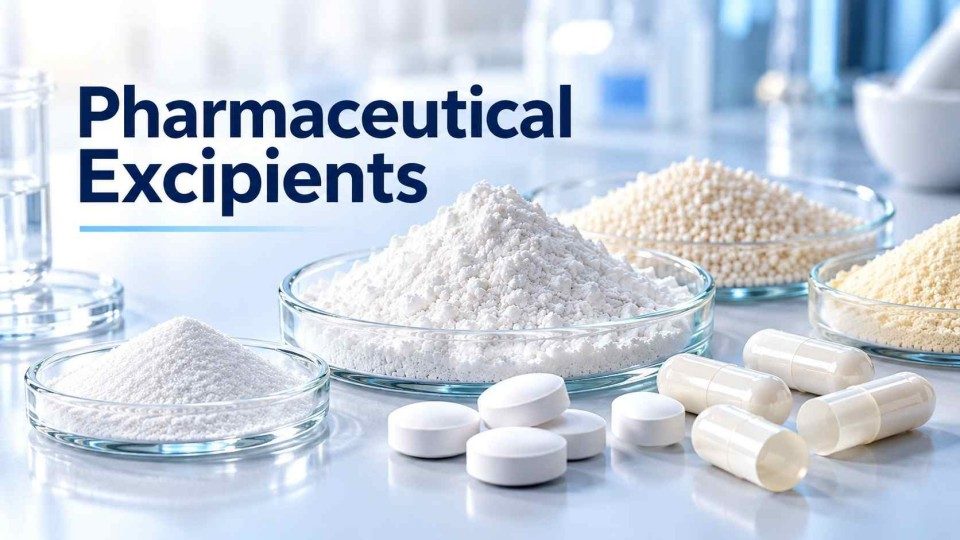
Pharmaceutical excipients are the non-API ingredients that help turn an active pharmaceutical ingredient (API) into a usable medicine. They give tablets bulk and strength, support consistent capsule filling, keep particles suspended in liquid medicines, and control the texture of creams and gels. Beyond shaping a dosage form, excipients can influence powder flow, tablet compression, stability, disintegration, dissolution, and drug release.
Common examples include lactose and microcrystalline cellulose (MCC) as fillers, povidone (PVP) as a binder, sodium starch glycolate and croscarmellose sodium as disintegrants, magnesium stearate as a lubricant, colloidal silicon dioxide as a glidant, and hydroxypropyl methylcellulose (HPMC) in binding or coating applications. These ingredients range from sugars and starches to cellulose derivatives, polymers, water, and oils. Although often called “inactive ingredients,” excipients are not necessarily functionally inert. Their purity, grade, concentration, and compatibility with the API all matter when selecting materials for safe, reliable drug manufacturing.
Unlike active pharmaceutical ingredients (APIs), which provide a medicine's intended pharmacological action, pharmaceutical excipients support how the drug is formulated, manufactured, stored, and delivered. Their main functions include:
The key point: Excipients do more than hold a formulation together. Their type, grade, concentration, and compatibility with the API can affect manufacturing efficiency, product quality, and how the medicine performs.
The main difference is their intended function. An API provides the drug's intended pharmacological action, while an excipient supports formulation, manufacturing, stability, delivery, or other product characteristics.
|
Feature |
Active Pharmaceutical Ingredient (API) |
Pharmaceutical Excipient |
|
Primary purpose |
Provides the intended pharmacological action |
Supports formulation and product performance |
|
Manufacturing role |
Incorporated into a suitable dosage form |
Can improve flow, compression, filling, or coating |
|
Key quality considerations |
Identity, strength, purity, and stability |
Material quality, functional properties, and compatibility |
|
Examples |
The active drug substance |
Lactose, MCC, povidone, magnesium stearate |
The term inactive ingredient is common in pharmaceutical regulation, but it does not mean that an excipient has no physical, chemical, or biological effects. Its role depends on its intended use in the specific product.
Pharmaceutical excipients are classified primarily by their functions. As explained in the IPEC-Americas excipient FAQs, excipients serve different roles in drug-product formulation and manufacture. The same material can perform more than one function depending on its grade, concentration, and formulation.
|
Excipient Type |
Main Function |
Common Examples |
|
Fillers / Diluents |
Increase formulation bulk |
Lactose, MCC, dibasic calcium phosphate |
|
Binders |
Promote particle adhesion and tablet strength |
Povidone (PVP), HPMC, gelatin, pregelatinized starch |
|
Disintegrants |
Help tablets break apart after contact with liquid |
Sodium starch glycolate, croscarmellose sodium, crospovidone |
|
Lubricants |
Reduce friction during compression and ejection |
Magnesium stearate, calcium stearate, stearic acid |
|
Glidants |
Improve powder flow |
Colloidal silicon dioxide, talc |
|
Compression Aids |
Support compaction and tablet formation |
MCC, selected co-processed excipients |
|
Film Formers / Coating Agents |
Form protective or functional coatings |
HPMC, HPC, ethylcellulose, shellac |
|
Antioxidants |
Help protect susceptible ingredients from oxidation |
Ascorbic acid, sodium metabisulfite |
|
Buffering Agents |
Adjust or maintain formulation pH |
Citrate buffers, phosphate buffers |
|
Preservatives |
Control microbial growth where required |
Methylparaben, sodium benzoate |
|
Solvents / Vehicles |
Dissolve, disperse, or carry ingredients |
Purified water, ethanol, polyethylene glycol (PEG) |
|
Suspending / Thickening Agents |
Modify viscosity and support dispersion stability |
Cellulose derivatives, carbomer |
|
Emulsifiers / Surfactants |
Support emulsification and wetting |
Polysorbates, lecithin |
|
Humectants |
Help retain moisture |
Glycerin, propylene glycol |
|
Sweeteners / Flavors / Colors |
Improve taste, appearance, or acceptability |
Sucrose, peppermint oil, permitted colorants |
Note: These are representative examples, not universal recommendations. An excipient may appear in more than one category because its function depends on the formulation. Suitability also depends on the dosage form, administration route, and applicable quality requirements.
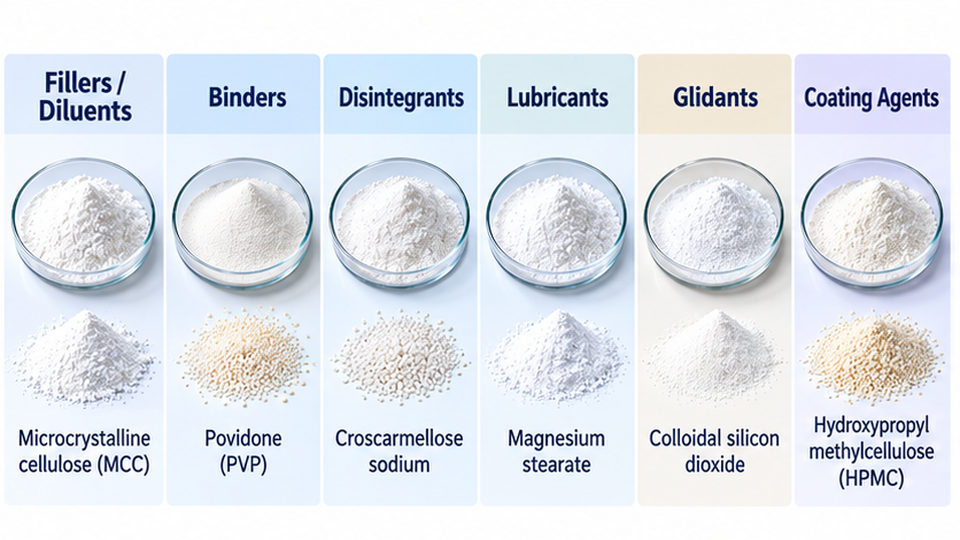 Common pharmaceutical excipients are grouped by function
These three excipient types perform different but complementary roles in tablet formulation.
These materials address specific manufacturing challenges.
Coating agents protect dosage forms, mask taste, improve appearance, or modify drug release. HPMC is used in immediate-release film coatings, while ethylcellulose can form part of release-controlling systems. Shellac is another coating material used in appropriate applications.
Stability-related excipients perform distinct functions:
Liquid and semi-solid formulations require excipients that control solubility, dispersion, viscosity, and physical stability.
Patient acceptability matters, particularly for oral liquids, chewable tablets, and orally disintegrating products.
Sweeteners and flavors help mask unpleasant tastes, while colorants support appearance or product identification. Color additives may be subject to separate authorization and use restrictions; a colorant permitted in one market or dosage form is not necessarily permitted in another.
Different dosage forms require different excipient combinations. A material suitable for an oral tablet should not automatically be assumed appropriate for an injectable or inhaled product.
Tablet formulations commonly use fillers, binders, disintegrants, lubricants, and glidants. Coated tablets also contain film-forming polymers and other coating components.
For example, a tablet might use MCC as a filler and compression aid, povidone as a binder, croscarmellose sodium as a disintegrant, magnesium stearate as a lubricant, and colloidal silicon dioxide as a glidant.
The formulation must balance manufacturability and product performance, including tablet strength, friability, content uniformity, disintegration, and dissolution. Not every tablet requires every excipient category.
Hard capsule fills may contain fillers, glidants, lubricants, and other functional ingredients.
Hard capsule shells commonly use gelatin or HPMC, which should be distinguished from the ingredients inside the capsule.
Powder flow, bulk density, compressibility, and the filling mechanism jointly influence capsule fill-weight consistency. Formulation development should therefore consider the selected capsule filling machine.
Liquid medicines may contain solvents, vehicles, suspending agents, emulsifiers, preservatives, sweeteners, and flavors.
Suspensions require suitable particle dispersion and physical stability, while solutions depend on solubility and ingredient compatibility. Preservative selection also depends on the formulation, intended use, and applicable requirements.
Creams, gels, and ointments use vehicles, emulsifiers, thickeners, and other ingredients to control consistency and physical stability.
Important formulation properties include viscosity, rheology, dispersion, and application characteristics.
Injectable and inhalation products have additional route-specific requirements, making excipient safety and suitability especially important.
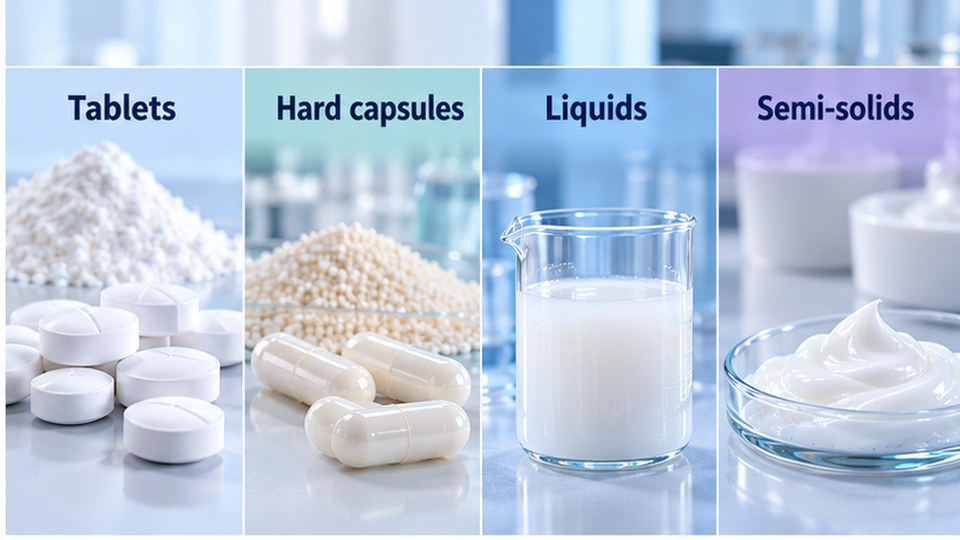 Excipients are selected according to dosage form, process requirements, and route of administration.
Excipient properties influence process consistency and finished-product quality. Particle size, morphology, moisture content, surface properties, and density can affect material handling and performance.
USP General Chapter <1059>, Excipient Performance, discusses the relationship between excipient characteristics and their functionality in drug products.
Consistent powder flow supports consistent die filling. When cohesive powders flow irregularly, the amount of material entering each tablet die may vary, contributing to tablet-weight variation.
At an appropriate concentration, colloidal silicon dioxide can reduce interparticle cohesion and improve powder flow. Its effect depends on the host powder's particle properties and the mixing process.
A published study on colloidal silica and powder flow examines these material-dependent effects.
During compression, particles rearrange, deform, or fragment and form bonds within the tablet.
Lubrication involves a trade-off. Magnesium stearate reduces die-wall friction, but greater particle-surface coverage can weaken bonding in lubricant-sensitive formulations. Excessive lubrication may reduce tablet tensile strength or delay dissolution. A practical way to evaluate this trade-off is to compare ejection force, tablet tensile strength, and dissolution under defined lubricant concentrations and blending conditions.
Research on magnesium stearate material properties and tablet performance illustrates why material grade and processing conditions must be evaluated together.
Disintegration is the breakup of a tablet; dissolution is the transfer of the drug substance into solution. They are different processes.
Disintegrants promote tablet breakup through water uptake and related mechanisms. Faster disintegration can increase exposed surface area, but it does not guarantee faster dissolution of a poorly soluble API.
Tablet porosity, compression force, lubricant distribution, API solubility, and other formulation characteristics determine the final dissolution behavior.
Capsule filling depends on both powder properties and equipment operation. Flowability influences material feeding, while bulk density and compressibility affect how much material occupies the filling volume.
Suitable fillers and glidants support consistent processing, but equipment selection must also account for the actual powder formulation. Rich Packing recommends evaluating capsule fill-weight variation at the intended operating speed rather than relying on rated machine speed alone.
A capsule-filling study investigated relationships between powder properties and filling performance.
Film coating combines formulation design with spraying, mixing, and drying.
Polymers determine key film properties, while plasticizers modify flexibility. Solvent selection and process conditions influence film formation and coating uniformity.
Incompatible materials or unsuitable processing conditions can contribute to uneven coatings and defects.
From formulation to production: Explore Rich Packing's tablet presses and capsule filling machines to match your powder characteristics, production requirements, and quality-control needs with suitable equipment.
Excipient selection requires evaluation of material quality, compatibility, functionality, safety, and suitability for the intended process and market.
API–excipient compatibility is a central selection requirement. An excipient must be suitable for the API, other ingredients, dosage form, and administration route.
Compatibility studies may use API–excipient mixtures, stress storage, and analytical testing to identify degradation or other interactions. Findings inform formulation development and subsequent stability studies.
The ICH Q8(R2) Pharmaceutical Development guideline emphasizes understanding how excipient selection, concentration, and material attributes affect drug-product quality and performance.
Applicable quality requirements may include standards in USP–NF, the European Pharmacopoeia (Ph. Eur.), or other recognized pharmacopoeias.
Pharmacopoeial compliance does not automatically guarantee functional suitability. Two MCC grades may meet applicable specifications yet differ in particle size or bulk density, affecting powder flow and compaction.
These properties are examples of functionality-related characteristics (FRCs): material attributes relevant to an excipient's intended performance. USP <1059> provides a framework for understanding excipient functionality.
Supplier qualification, traceability, manufacturing controls, and risk management also matter. IPEC publishes industry guidance on excipient GMP and supplier qualification; such guidance should be distinguished from binding regulatory requirements.
The FDA does not maintain a universal list of independently approved pharmaceutical excipients. Excipients are evaluated in the context of their intended use in drug products.
The FDA Inactive Ingredient Database (IID) provides information about inactive ingredients used in FDA-approved drug products.
Previous use in a particular dosage form and administration route can inform development, but it does not establish suitability for every concentration, route, or new formulation.
Novel excipients may provide additional formulation capabilities but can require supporting safety data based on the intended exposure, duration, and route. The FDA guidance on nonclinical safety evaluation of pharmaceutical excipients provides relevant context.
Co-processed excipients combine materials through joint processing to obtain targeted functional properties. Silicified MCC, for example, combines cellulose-based compaction characteristics with the contribution of colloidal silicon dioxide to powder handling.
Performance advantages must be demonstrated in the intended formulation rather than assumed from the material category.
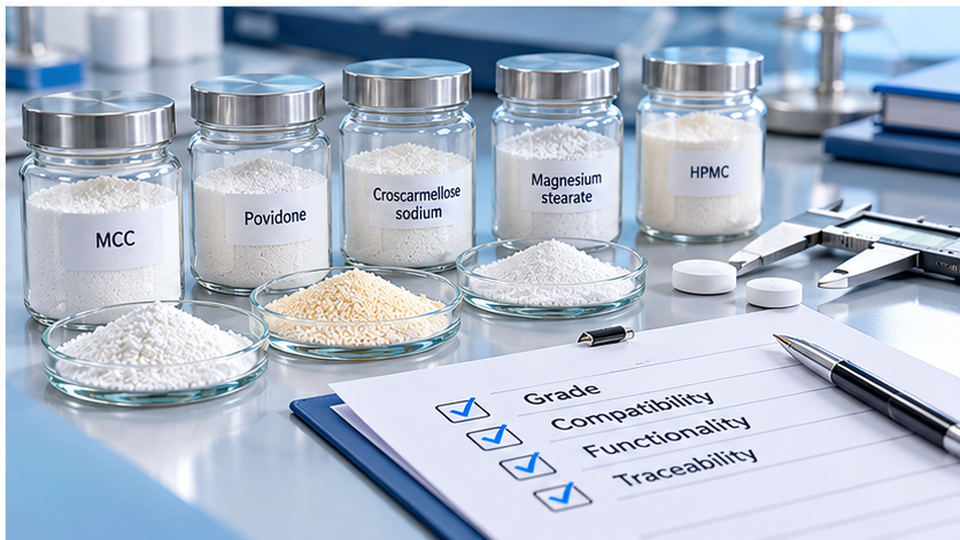 Excipient selection depends on grade, compatibility, functionality, quality controls and intended use.
Common examples include MCC, lactose, magnesium stearate, colloidal silicon dioxide, povidone, HPMC, and superdisintegrants such as croscarmellose sodium. There is no single excipient combination suitable for every medicine; selection depends on the dosage form and manufacturing process.
An API provides the intended pharmacological action, while an excipient supports the drug product's formulation and performance. Classification depends on the ingredient's intended function in the specific medicine, not simply its chemical identity.
Yes. MCC acts as a filler and compression aid, while HPMC can function as a binder or film former. The relevant function depends on material grade, concentration, and formulation design.
Tablets commonly contain fillers, binders, disintegrants, and lubricants. Glidants and coating agents are added when needed. Direct-compression formulations may place greater emphasis on powder flow and compaction properties than formulations using granulation.
Disintegrants help expose drug particles to liquid, while lubricants, binders, and coatings influence wetting or release. Excessive hydrophobic lubrication can delay dissolution in sensitive formulations, but faster tablet disintegration does not necessarily mean faster API dissolution.
Safety depends on the ingredient, amount, route of administration, exposure duration, and intended use. A history of use in approved drug products provides useful information but does not automatically establish safety for a different formulation or administration route.
1. IPEC-Americas. Excipient FAQs.
2. United States Pharmacopeia (USP). USP General Chapter <1059>: Excipient Performance.
3. International Council for Harmonisation (ICH). ICH Q8(R2): Pharmaceutical Development.
4. U.S. Food and Drug Administration (FDA). Inactive Ingredients in Approved Drug Products — Frequently Asked Questions.
5. U.S. Food and Drug Administration (FDA). Nonclinical Studies for the Safety Evaluation of Pharmaceutical Excipients.

29+ years in pharmaceutical machinery, covering capsule filling, tablet pressing, blister packaging, tablet and capsule counting, cartoning, GMP production, and overseas machine service.

Correo electrónico : manager@richpacking.cn
Building D, No. 226, Beishan Qiaotou Street, Haizhu District, Guangzhou City, Guangdong Province, China


 Red IPv6 admitida