






 Casa
 Productos
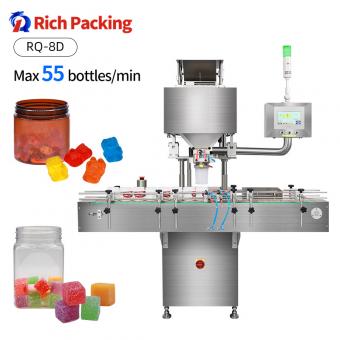
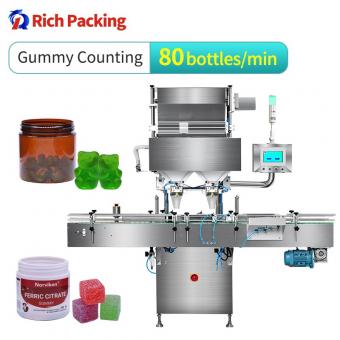
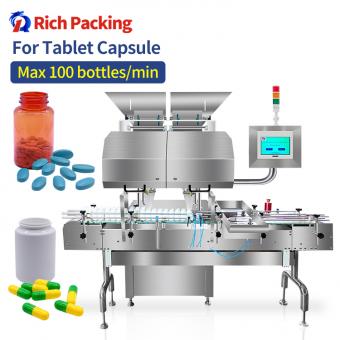
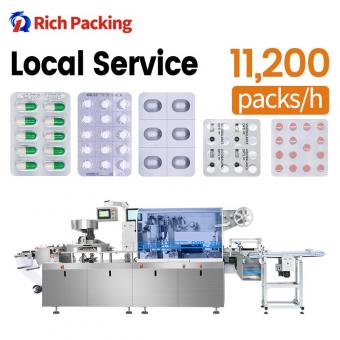
29+ years in pharmaceutical machinery, covering capsule filling, tablet pressing, blister packaging, tablet and capsule counting, cartoning, GMP production, and overseas machine service.

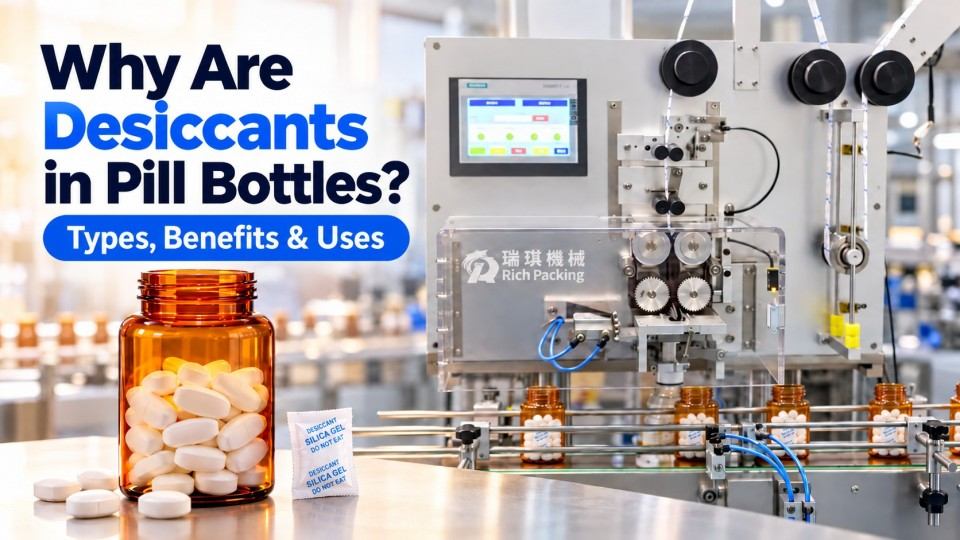
A desiccant in a pill bottle is a small packet or plastic canister placed alongside tablets or capsules to control moisture. The packet often contains silica gel, while other types use molecular sieves or clay. These materials trap water vapor inside the bottle, helping protect medicines from humidity. Without enough moisture protection, certain tablets can soften, stick together, or deteriorate during storage. Some capsule shells can also become too soft or brittle when humidity is unsuitable.
For example, effervescent tablets react readily with water, making moisture control especially important. A desiccant helps protect these tablets, but it works together with the bottle, cap, and seal rather than replacing them. Not every medicine needs a desiccant. Pharmaceutical manufacturers select the appropriate type and amount based on the drug's moisture sensitivity and packaging requirements.
A desiccant is a moisture-absorbing material placed inside a pill bottle to help keep tablets and capsules dry. It usually comes in a small sealed packet or plastic canister. The packet holds materials such as silica gel, which has millions of tiny pores that attract and hold water molecules. This process is called adsorption. Water vapor can enter the packet, but the desiccant particles remain enclosed.
Desiccant in pill bottle packaging addresses two main sources of moisture:
Not every pill bottle needs a desiccant. Its use depends on the medicine's moisture sensitivity and the protection provided by the bottle, cap, and seal.
Pill bottle desiccants are classified by material and packaging form. Silica gel, molecular sieves, and clay capture water vapor; sachets, canisters, and caps hold those materials in different ways.
|
Material |
Moisture-Control Characteristic |
Selection Consideration |
|
Silica gel |
Capacity generally increases as RH rises |
Suitable candidate for many moderate-RH applications |
|
Molecular sieve |
Strong adsorption at low RH |
Consider where very low humidity is justified |
|
Bentonite clay |
Adsorbs over a range of RH |
Verify grade, performance, and suitability |
Table 1. Desiccant materials compared. Performance depends on the material grade, temperature, and relative humidity (RH).
For example, silica gel usually holds more moisture at higher RH than at very low RH, while a molecular sieve can remain effective when the air is already dry. Engineers use an adsorption isotherm—a curve showing water uptake at a specified humidity and temperature—to compare them. What matters is capacity at the intended RH, not maximum capacity at high humidity.
|
Form |
Main Advantage |
Limitation |
|
Sachet |
Compact; suitable for reel-fed insertion |
Can fold, jam, or be damaged during cutting |
|
Canister |
Fixed dimensions simplify handling |
Occupies space; must fit bottle opening |
|
Desiccant cap |
Eliminates separate insertion |
Depends on the complete closure design |
Table 2. Common desiccant packaging formats and their trade-offs.
A reel-fed sachet needs precise cutting; an integrated cap eliminates that operation. The right choice depends on the product, bottle design, and packaging process.
The main benefit of a pharmaceutical desiccant is controlling humidity during storage. It can limit physical changes and moisture-related degradation in sensitive tablets or capsules. The value depends on the formulation.
For example, a moisture-sensitive tablet may retain its appearance but show a change in dissolution after storage. In that case, the benefit is not merely keeping the tablet dry: it is preserving the quality attributes established during development.
A desiccant works with the bottle, not instead of it. An HDPE bottle, cap, liner, and induction seal restrict moisture entering from outside. A desiccant captures part of the water already present or passing through the barrier. If the cap is loose or the seal is damaged, the desiccant can become exhausted sooner. That is why medicine bottle seals must be considered alongside the drying material.
Once a multidose bottle is opened, room air can introduce more moisture. A desiccant supports the product's validated shelf life; it does not automatically extend the expiration date. Its remaining capacity matters during repeated use.
Desiccant selection begins with the medicine's moisture sensitivity, not the size of the bottle. Manufacturers need to know the humidity the product can tolerate, how much moisture is already present, and how much can enter the finished package during storage.
A desiccant used in pharmaceuticals must be assessed as a finished packaging component. Key selection factors are:
There is no universal grams-per-bottle rule. A small bottle with a weak moisture barrier may admit more water than a larger, well-sealed one. The useful calculation adds moisture from the headspace, the product, and moisture entering during storage, then compares that total with the selected desiccant's usable capacity at the target RH.
For instance, consider this entirely hypothetical screening calculation, not a recommended dose:
|
Example Input |
Assumed Value |
|
Bottle / headspace |
75 mL HDPE bottle / 35 mL air |
|
Temperature and RH |
25°C; 50% initial RH; 20% target RH |
|
Average complete-package moisture ingress |
0.20 mg/day under assumed storage conditions |
|
Sealed storage period |
730 days = 146 mg entering |
|
Product moisture released toward target RH |
100 mg, assumed from product sorption behavior |
|
Moisture removed from headspace |
Approximately 0.2 mg |
|
Total expected water load |
Approximately 246.2 mg |
|
Net usable desiccant capacity |
0.10 g water/g, assumed at 20% RH and 25°C |
|
Theoretical minimum mass |
About 2.46 g, before design allowance |
Table 3. Hypothetical moisture balance. The assumed ingress rate is not a universal HDPE-bottle value; real calculations need measured package MVTR and product/desiccant isotherms.
The 2.46 g result is only a starting estimate, not a usable prescription. It excludes repeated opening and design uncertainty. Changing the storage conditions, bottle barrier, or desiccant grade changes the answer; package studies and real-time and accelerated stability testing must confirm the final choice.
USP <670> identifies desiccants as auxiliary packaging components; USP <671> addresses moisture-vapor performance of relevant packaging systems. Neither requires every pill bottle to contain a desiccant. The FDA's August 2026 container-closure guidance is still a draft, not a final rule.
On an automatic electronic tablet counting line, a desiccant is commonly inserted after tablet or capsule counting and before capping and induction sealing. The task is to place the correct, undamaged insert into each bottle that needs one, without interrupting production.
For a reel-fed sachet, an inserter advances the connected packets, locates the cut position, separates one packet, and drops it into a waiting bottle. A bottle sensor prevents release without a bottle. Rigid canisters use a singulating feeder rather than a cutter.
A typical sequence is bottle unscrambling → counting → filling → desiccant insertion → verification → capping → induction sealing → labeling. The exact order and equipment vary with the line. A desiccant inserter must be synchronized with bottle movement and the downstream capping equipment.
For example, a cutter sensor can confirm that a cutting stroke occurred, but cannot prove that an intact packet entered the bottle. Machine action and actual insert presence are two different checks. Depending on the bottle and insert, a dedicated sensor or vision system can confirm insertion, while a rejection system removes failed bottles.
Rich Packing's high-speed desiccant inserter uses on-demand feeding and multiple detection points to help synchronize desiccant delivery with bottle movement and maintain consistent insertion on tablet and capsule bottling lines. During changeover, operators should check packet size, feed position, bottle timing, detection, and reject response with the actual material. These are practical process controls, not a specific sensor configuration mandated by the FDA.
Desiccants in pill bottles help protect moisture-sensitive medicines, but their performance depends on the whole package. Silica gel, molecular sieves, and clay behave differently, while packets, canisters, and caps suit different bottle designs. The right choice comes from the medicine's humidity requirements, the bottle's moisture barrier, and verified desiccant capacity—not a standard number of grams. On automatic lines, accurate insertion and checks are just as important as selecting the material.
Follow the medicine's packaging instructions. Unless the labeling directs otherwise, do not remove or open a desiccant supplied with the medicine. Keep it away from children and never treat it as a dose.
An intact pharmaceutical-grade packet is designed for its packaging use, not for eating. Seek medical or poison-control advice after accidental ingestion or choking; do not assume all silica gel packets are identical.
No. Some products remain stable with the container and closure alone; others need a desiccant as part of their tested package.
The amount depends on product moisture sensitivity, usable desiccant capacity at the target RH, the complete-package MVTR, and expected storage time. There is no standard amount for every bottle size.
There is no fixed number of months. Its remaining capacity depends on the material, initial moisture loading, bottle barrier, storage humidity, shelf life, and how often the bottle is opened.
Yes. Excessively low RH can make gelatin shells brittle. The specified humidity range must be verified for the capsule and its fill.
References

29+ years in pharmaceutical machinery, covering capsule filling, tablet pressing, blister packaging, tablet and capsule counting, cartoning, GMP production, and overseas machine service.

Correo electrónico : manager@richpacking.cn
Building D, No. 226, Beishan Qiaotou Street, Haizhu District, Guangzhou City, Guangdong Province, China


 Red IPv6 admitida