






 Casa
Casa Productos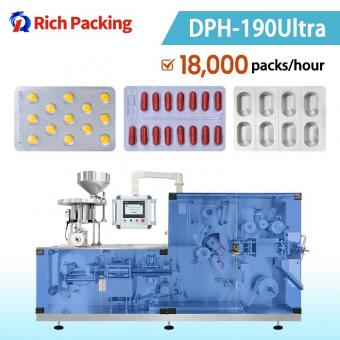
29+ years in pharmaceutical machinery, covering capsule filling, tablet pressing, blister packaging, tablet and capsule counting, cartoning, GMP production, and overseas machine service.

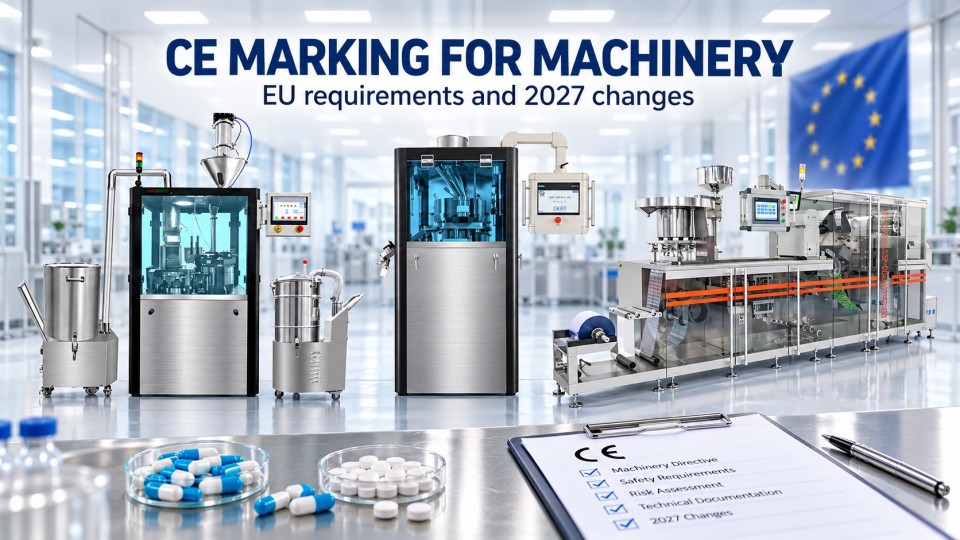
CE marking for machinery means the manufacturer declares that a machine meets the EU requirements applicable to it. It is not an EU-issued approval, and third-party certification is not always required. For a capsule filling machine, tablet press, or blister packaging machine, conformity involves identifying hazards, applying appropriate safeguards, assessing relevant electrical and other requirements, and maintaining technical documentation.
For buyers, the key is to check the machine's Declaration of Conformity, instructions, and identification—not simply accept a PDF labeled “CE Certificate.” The documents should match the manufacturer, model, and delivered configuration. From 20 January 2027, Regulation (EU) 2023/1230 becomes the main EU machinery law. Understanding these requirements helps buyers verify a machine's safety documentation before purchase, shipment, or installation.
CE marking means the manufacturer takes responsibility for meeting the EU product requirements that apply to the machine. It is a legal conformity mark, not a quality ranking or a certificate awarded by an EU office.
Imagine two capsule fillers carrying the same CE logo. One has an interlocked access door; the other has a different guarding arrangement. The logo alone cannot explain whether either design controls its hazards adequately. You need the risk assessment behind the design, the relevant safeguards, and the required documents.
The marking also does not mean a machine is suitable for every pharmaceutical process. A machine can satisfy applicable machinery requirements while still needing site-specific qualification, cleaning validation, and integration work.
Not exactly. People often say “CE certified,” but CE marking and third-party certification are different things.
For many machinery types, the manufacturer can complete the permitted conformity assessment procedure without a Notified Body. For certain categories and assessment routes, an authorised third party must participate.
A PDF titled “CE Certificate” could be a voluntary test certificate, a laboratory report, or an actual Notified Body document. Its title does not tell you which. Ask for the signed EC Declaration of Conformity under the current Machinery Directive, or the EU Declaration of Conformity under the new Regulation, as appropriate.
Then check whether any additional certificate covers the exact model and the legislation claimed. An impressive-looking document for a different machine is not useful evidence.
The manufacturer must identify applicable legislation, assess risks, apply protective measures, prepare technical documentation, complete the relevant conformity assessment, and provide the required declaration and instructions. Importers and distributors have their own obligations.
Be careful with unfinished equipment. Partly completed machinery cannot yet perform its intended application on its own. Under the current Directive, it normally comes with a Declaration of Incorporation and assembly instructions, not a machinery Declaration of Conformity or CE mark under that Directive. Other EU legislation may still require CE marking.
Connected equipment introduces another question: who is responsible for the complete line? A blister packer, conveyor, and cartoner may each have their own declaration, but their combined controls and transfer points can create new hazards. The integrated assembly may require its own conformity assessment.
The requirements follow the machine's actual risks. Start with the applicable law, then examine how the design protects people during production, cleaning, changeovers, and maintenance.
Until 19 January 2027, Machinery Directive 2006/42/EC remains the main EU machinery framework. Its Annex I sets out Essential Health and Safety Requirements, often shortened to EHSRs.
These address matters such as control-system safety, moving parts, electrical hazards, stability, maintenance, information for users, and hygiene where relevant. Manufacturers assess which requirements apply; they do not just attach a generic checklist to every product.
Consider a tablet press. Its rotating turret and compression rollers create crushing and trapping hazards. A blister machine adds heated surfaces, moving film, and cutting stations. Different hazards call for different safeguards, even when both machines carry CE marking.
EN ISO 12100 provides a widely used method for machinery risk assessment and risk reduction. The practical sequence is straightforward: define the machine's limits, identify hazards, estimate and evaluate risks, then reduce them.
The order of risk reduction matters. First try to design out the hazard. Where that is not enough, use guards or protective devices. Finally, explain remaining risks through instructions, training information, and warnings.
For example, a warning about a moving cutting blade cannot replace a guard where access must be prevented. Likewise, an emergency stop is not a substitute for an effective protective door.
Harmonised European standards are generally voluntary. When their references are published in the EU Official Journal, correct application can provide a presumption of conformity for the specific requirements they cover. A standard's name on a brochure is not evidence that its provisions were actually applied.
An interlock should do more than trigger a message on a screen. Its purpose, response, reliability, and behaviour after a fault must suit the risk assessment. If a door opens while hazardous motion continues, the stopping time and possible access to moving parts matter.
At Rich Packing, our NJP-1500D capsule filling machine features door controls, an emergency-stop arrangement, and automatic alarms and stopping for material shortages or mechanical faults. These are practical features to inspect during factory acceptance testing; each safety function still needs assessment for the supplied configuration.
 Machinery safety inspection on a capsule filling machine in a pharmaceutical cleanroom
Electrical conformity is not just a question of using branded components. The finished machine needs appropriate protection against electric shock, overheating, unintended starting, and other relevant electrical hazards.
Under the current Machinery Directive, the safety objectives of the Low Voltage Directive apply to machinery's electrical hazards, but the machinery conformity assessment procedure governs those hazards. A separate Low Voltage Directive certificate is not automatically required.
The EMC Directive 2014/30/EU may also apply. A servo-driven machine should neither cause unacceptable electromagnetic interference nor malfunction because of interference within its applicable operating conditions.
Think of the process as a trail you can follow from a hazard to a safeguard and then to evidence that the safeguard works. A CE logo is the final visible step, not the first.
Suppose a factory test shows that a guard can be opened before a cutter stops. That is not a paperwork issue. The design or control system needs attention, by renewed verification and updated records.
|
Document |
Purpose |
What the buyer should check |
|
EC/EU Declaration of Conformity |
Formal manufacturer declaration |
Correct manufacturer, model, applicable laws, date and signature |
|
Instructions for use |
Safe installation, operation and maintenance |
Required language, warnings, cleaning and service procedures |
|
Technical file |
Design and conformity evidence retained by the manufacturer |
Confirm that relevant evidence exists; full disclosure is not automatic |
|
Test and inspection records |
Verification of specified requirements |
Tested model, configuration, method and results |
|
Notified Body certificate, where required |
Evidence of the applicable third-party procedure |
Issuer, scope, validity and machine covered |
|
Generic “CE Certificate” |
Meaning varies with its issuer |
Never accept the title alone as proof of compliance |
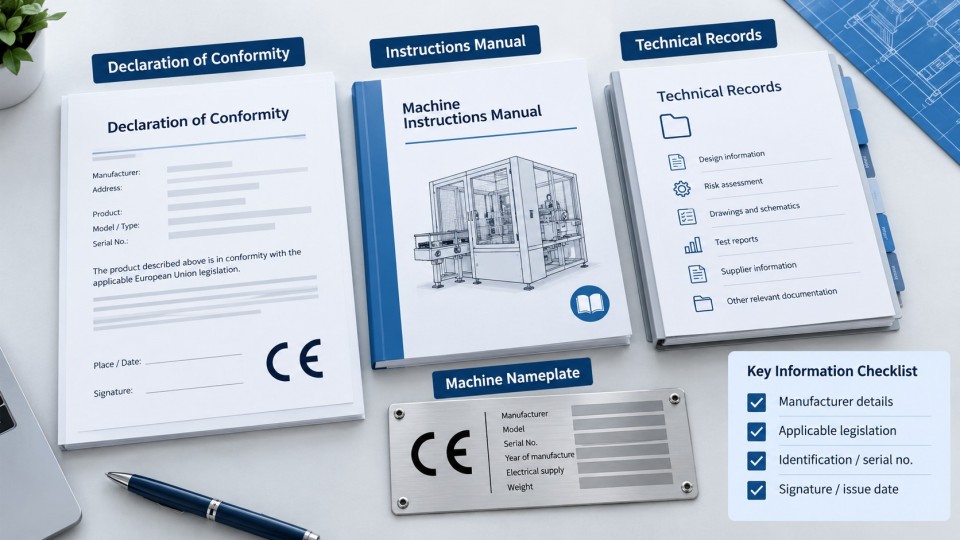
The technical file generally remains with the manufacturer and must be available to the competent authorities. Buyers are not automatically entitled to every proprietary drawing or full risk assessment. The relevant frameworks generally require technical documentation to be retained for at least 10 years.
Still, you can ask for meaningful supporting evidence. A functional test report, an explanation of safety-related control functions, or a factory demonstration can make a procurement review much more useful than collecting certificates without reading them.
A Notified Body is an organisation designated for specified EU conformity assessment activities. Its involvement is not mandatory for every capsule filler, tablet press, or packaging machine.
Under the current Directive, certain machinery categories appear in Annex IV, with the permitted assessment route depending on the conditions. Under the new Regulation, Annex I divides specified categories into Part A and Part B. Part A requires a Notified Body procedure; Part B can permit internal production control when the legal conditions are satisfied.
If a supplier claims third-party approval, verify the organisation and its notification scope through the European Commission's NANDO system. The laboratory's reputation alone does not establish that it was notified for that procedure.
Before shipment, compare the declaration, nameplate, manual, purchase order, and final configuration. Check any changes to guards, feeders, software, voltage, or interfaces.
A declaration covering a standard model may not automatically cover a modified line. Ask who assesses the changes and who signs for the delivered assembly.
During factory acceptance testing (FAT), request safe demonstrations of relevant door interlocks, emergency stops, fault responses, and restart behaviour. Record any open items before shipment rather than trying to resolve them during installation.
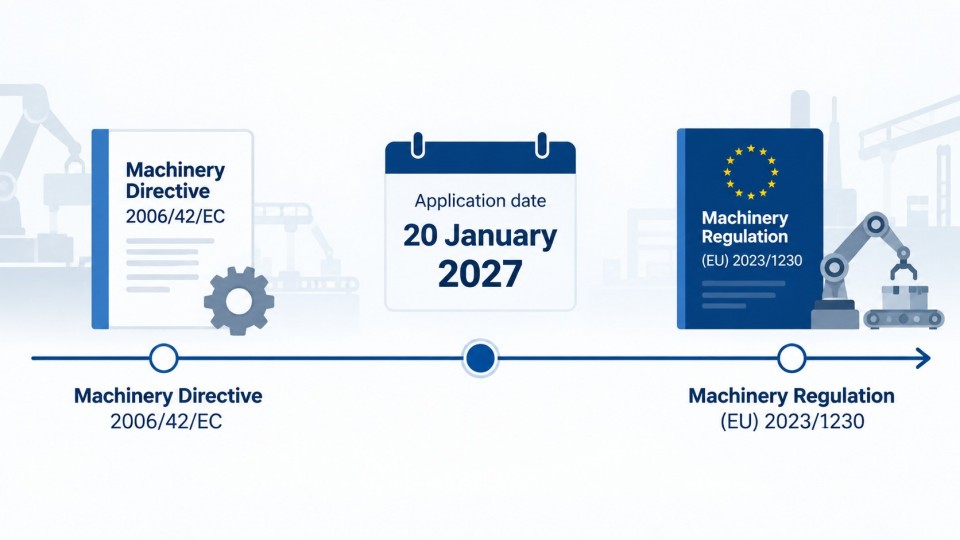
Regulation (EU) 2023/1230 becomes the main machinery framework on 20 January 2027. The date was corrected from 14 January 2027 in an official corrigendum. Some provisions already apply earlier, but the main transition occurs in January 2027.
|
Topic |
Directive 2006/42/EC |
Regulation (EU) 2023/1230 |
|
Main application period |
Through 19 January 2027 |
From 20 January 2027 |
|
Legal form |
Transposed into Member State law |
Directly applicable across Member States |
|
Essential safety requirements |
Annex I |
Annex III |
|
Machinery declaration |
EC Declaration of Conformity |
EU Declaration of Conformity |
|
Higher-risk machinery categories |
Annex IV |
Annex I, Parts A and B |
|
Instructions |
Directive-era requirements |
Conditional digital instructions expressly addressed |
|
Digital and modification risks |
Existing principles and guidance |
More explicit provisions on safety-related digital risks and substantial modification |
The new Regulation expressly permits digital instructions under conditions. They must be downloadable, savable, and printable, and accessible online for the expected lifetime of the machinery and at least 10 years after placement on the market.
When the user requests paper instructions at the time of purchase, the manufacturer must supply them free of charge within one month. Instructions also need to meet applicable language and accessibility requirements.
The EU Declaration of Conformity may be supplied with the machine or made accessible through a web address or machine-readable code in the specified information. A QR code is convenient, but the underlying document must remain available as required.
Modern equipment uses networked controllers, recipes, remote diagnostics, and software updates. The new Regulation explicitly addresses protection against corruption of safety-related hardware, software, and data where that corruption could create hazards.
This does not mean every connected machine needs the same cybersecurity system. It means the risk assessment must consider how interference or changes could affect safety functions.
A substantial modification can be physical or digital. If an unforeseen change creates a new hazard or increases an existing risk and requires significant new protective measures, the person making that change may take on manufacturer responsibilities.
Changing a production recipe is not automatically a substantial modification. Reprogramming a safety function so an operator can access hazardous motion is a very different matter.
No automatic recertification is required simply because the calendar reaches 20 January 2027. Machinery lawfully placed on the EU market under the Directive before that date benefits from transitional provisions.
The important phrase is placed on the market. A machine ordered or manufactured in 2026 but first placed on the EU market in February 2027 cannot assume that the old Directive applies.
Plan the applicable declaration and conformity assessment around the actual project timeline. Later substantial modifications may create new obligations even for an older machine.
A useful CE review connects the paperwork to what your operators will do every day. Start with access, faults, cleaning, and integration—not the supplier's certificate folder.
Ask to see what happens when an access door opens, when a machine stops unexpectedly, and when power returns. Check that restarting requires the intended operator action and that dangerous movement cannot begin unexpectedly.
For a tablet press, look at access to the turret and compression zone. For blister packaging, consider heated sealing tools, film transport, and cutting stations. For capsule filling, focus on moving stations, door access, and safe cleaning.
The presence of an emergency-stop button is not enough. Ask which hazards it addresses and whether the stopping function has been verified against the assessed risk.
Pharmaceutical machinery needs more than attractive stainless-steel panels. Product-contact surfaces should suit the material, and operators need practical access for cleaning and inspection. Powder traps, difficult-to-reach corners, and lubricant migration deserve attention.
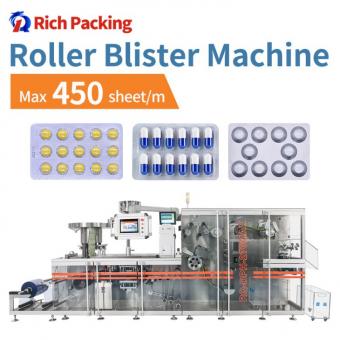
Our RQ-HGZP tablet presses use enclosed compression chambers, dust extraction, and separated lubrication; our DPH-270Max blister packaging machine uses independently controlled stations and material-feed fault monitoring. Ask Rich Packing for the declaration, instructions, and relevant safety checks covering your selected configuration.
Keep the compliance boundaries clear: CE marking is not GMP certification. Installation Qualification (IQ), Operational Qualification (OQ), Performance Qualification (PQ), cleaning validation, and process suitability depend on the pharmaceutical application and site.
|
Checkpoint |
Practical question |
|
Machine identification |
Do the nameplate, quotation and declaration describe the same equipment? |
|
Applicable legislation |
Are the rules appropriate for the machine and market-placement date? |
|
Declaration |
Is the correct EC/EU declaration signed and available? |
|
Guarding and controls |
Can the relevant protective functions be demonstrated safely? |
|
Electrical and EMC |
Is suitable conformity evidence available for the final configuration? |
|
Instructions |
Are installation, cleaning, maintenance and residual risks covered? |
|
Modifications |
Who assesses custom feeders, software changes and added conveyors? |
|
Pharmaceutical suitability |
Is there a separate plan for GMP and qualification requirements? |
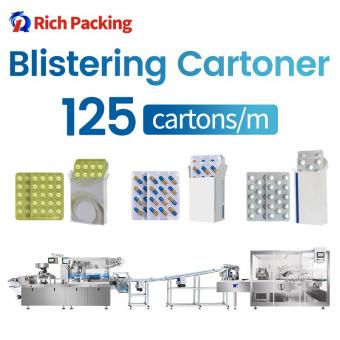
When a capsule filler feeds a downstream machine, or a blister packer connects to a cartoner, the transfer points and shared controls deserve special attention. Ask who supplies the stop logic, who assesses access between machines, and who is responsible for the complete assembly where applicable.
It is easier to settle those responsibilities during quotation and design review than after installation. Request the model-specific documentation package, agreed FAT checks, and clear ownership of integration work before approving shipment.
No. CE marking normally reflects the manufacturer's conformity assessment and declaration. EU authorities enforce the rules, while a Notified Body participates only when the applicable procedure requires one.
Yes. A machine made for one customer's production line is not automatically exempt. Its classification, intended use, and whether it is placed on the market or put into service determine the obligations.
The CE symbol itself does not carry a general expiry date. Conformity must remain valid for the product and applicable requirements; particular third-party certificates can have their own validity conditions.
Yes. Component origin is not the deciding factor. The complete machine must satisfy the applicable EU requirements, and component documentation alone cannot replace assessment of the finished design.
The date and circumstances of its first placement on the EU market matter more than the purchase-order date. Confirm the applicable framework before shipment.
No. Individual machine declarations do not automatically address new hazards caused by combined controls, conveyors, or shared access points. The integrated assembly may need a separate assessment.
Ask which legislation will apply, who signs the declaration, which safety functions can be demonstrated at FAT, and who handles conformity if the configuration changes.
The bottom line: CE marking is a promise backed by risk assessment, safeguards, and documentation. A strong buying decision checks all three—and makes the manufacturer explain how they apply to the machine you will actually receive.
· European Commission machinery guidance

29+ years in pharmaceutical machinery, covering capsule filling, tablet pressing, blister packaging, tablet and capsule counting, cartoning, GMP production, and overseas machine service.

Correo electrónico : manager@richpacking.cn
Building D, No. 226, Beishan Qiaotou Street, Haizhu District, Guangzhou City, Guangdong Province, China


 Red IPv6 admitida